

With the cost of groceries and everyday living continuing to rise, I think this is a good time to get back to some old-fashioned common sense.
Being frugal doesn't mean we have to go without everything we enjoy. For our family, it's really about being intentional with what we have, avoiding unnecessary waste, and spending our money on the things that matter most.
These aren't habits I started overnight. Most of them are things I've learned and incorporated into our lives over many years.
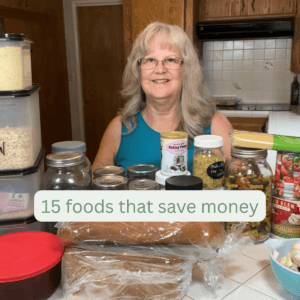
And please don't look at this list and think you need to start doing all 15 tomorrow!
Pick one or two ideas that would make the biggest difference in your household. Work on those until they become habits, and then add another one or two.
Small changes really do add up.
🖨️ Want a Printable Copy?
Several of you asked if you could print these tips, so I put all 15 Frugal Habits into a simple, printer-friendly PDF for you.
Prefer to watch instead? I recently shared all 15 of these frugal habits on my YouTube channel, The Common Sense Grandma.
1. Meal Plan Before You Shop
Meal planning is probably one of the biggest ways I save both money and my sanity.
I usually plan our dinners for two weeks at a time. I don't necessarily assign a meal to every specific day. Instead, I make a list of meals we can choose from depending on our schedule and what sounds good that evening.
Before I make my grocery list, I check the refrigerator, freezer and pantry to see what we already have.
This helps me use food before it goes to waste and keeps me from buying ingredients we don't need.
Want to try my system?
I have a FREE Meal Planning Bundle that you can print and use at home.
2. Cook From Scratch
Cooking from scratch is one of the foundations of how we eat in our home.
That doesn't mean I make absolutely everything from scratch. I make the things that make sense for us.
Bread, breadcrumbs, seasoning mixes, soup mixes, salad dressings and other simple pantry staples can often be made at home for much less than buying the packaged versions.
I also like knowing exactly what's going into our food.
3. Buy Pantry Staples in Bulk
For foods we use regularly, buying in bulk can save quite a bit of money.
Some of the staples I like to keep on hand include:
- Wheat
- Oatmeal
- Rice
- Dry beans
- Flour
- Sugar
But here's an important part of buying in bulk: a large package isn't a bargain if your family won't use it.
I stick primarily to foods I know we'll eat and that store well.
4. Cook Once, Eat Twice
When I'm making dinner, I often make enough to have leftovers for lunch the next day.
Lunch is already made, we're less tempted to pick something up, and nothing goes to waste.
Sometimes the simplest frugal habits are the best ones!
5. Try the Store Brand
There are plenty of foods where I don't notice enough difference between the store brand and name brand to justify paying more.
Some good places to compare prices are:
- Tomato products
- Beans
- Sugar
- Flour
- Frozen vegetables
- Basic pantry staples
I always compare ingredients and prices rather than assuming one is the better deal.
6. Brew Your Own Coffee
Those coffee shop visits can add up quickly.
Making coffee at home is such a small thing, but when you look at the cost over an entire year, it can make a surprisingly big difference.
I enjoy my coffee just as much at home-and I would rather put that extra money toward groceries, our family, or something we really need.
7. Use the 24-Hour Rule
This is especially helpful with online shopping.
When I see something I think I want, I try to wait at least 24 hours before purchasing it.
Often, after a day has passed, I realize I don't need it nearly as much as I thought I did.
Before buying, ask yourself:
Do I really need this?
Do I already own something that will do the same job?
Would I still buy it if I had to go to a store to get it?
That last question can be very revealing!
8. Have No-Spend Days
Try choosing one or two days during the week when you don't spend any money.
No Amazon order.
No restaurant.
No quick stop at the store.
Instead, eat what you already have, make your coffee at home, and find something free to do.
It's a simple way to become more aware of how often we spend money without really thinking about it.
9. Buy Quality Items Secondhand
I don't believe everything has to be brand new.
Over the years, we've bought many things used, including cars, kitchen appliances, books and clothing.
Depending on what I'm looking for, I'll check places such as thrift stores, eBay, Facebook Marketplace and other secondhand sources.
The key is buying something because you need it-not buying something simply because it's a bargain.
10. Combine Your Errands
Instead of making multiple trips throughout the week, I try to combine errands whenever possible.
Groceries, banking and other stops can often be handled during one outing.
That saves gasoline, time and wear on the car-and it also keeps me out of the stores!
11. Review Your Subscriptions
Subscriptions have a way of quietly accumulating.
Take a few minutes occasionally to look through your bank or credit-card statement.
Are you paying for streaming services you rarely watch?
Apps you forgot you subscribed to?
Memberships you're no longer using?
A few small monthly charges can turn into hundreds of dollars over a year.
12. Use Cash Envelopes When You Need Them
We don't necessarily use a cash-envelope system all the time, but we've used it when we needed to tighten up certain areas of our budget.
There's something about physically seeing the money leave an envelope that makes spending feel much more real.
If you're struggling to stay within a grocery, entertainment or personal-spending budget, cash envelopes may be worth trying.
13. Replace Paper Towels With Reusable Cloths
We use reusable microfiber towels around our home instead of reaching for paper towels every time something needs to be wiped up.
We wash them and use them again and again.
It's a very simple change, but it's one less disposable product we're continually buying.
14. Unplug What You're Not Using
Electronics and appliances can continue drawing small amounts of electricity even when they're not actively being used.
I don't obsess over every plug in the house, but unplugging things we aren't using is another simple habit that can help reduce unnecessary energy use.
Remember, frugality doesn't have to be complicated.
15. Look for Free Entertainment
Having fun together doesn't have to cost a lot of money.
Look around your own community for free or inexpensive activities such as:
- Local parks
- Library activities
- Church events
- Outdoor concerts
- Community movie nights
- Walking or hiking
- Gardening
- Family game nights
Some of the best family memories don't cost anything.
One More Frugal Habit: Use What You Already Have
Before I buy more, I try to look at what we already own.
That applies especially to food.
What's hiding in the freezer?
What vegetables need to be eaten?
What's sitting in the pantry?
Could those ingredients become tonight's dinner?
"Use what you have first" is one of the simplest frugal rules there is.
Start With Just One or Two
If you're reading this list thinking, "I should be doing all of these," please don't put that pressure on yourself.
Choose just one or two.
Maybe you'll start meal planning.
Maybe you'll make coffee at home instead of stopping at the drive-thru.
Maybe you'll try a no-spend day each week.
Practice those habits until they start to feel natural. Then add another one or two.
That's how we've developed many of our frugal habits over the years-not all at once, but little by little.
Small changes, repeated over time, can lead to big results.
For me, frugal living isn't about deprivation. It's about being intentional with what God has blessed us with.
When we spend less on things that don't matter, we have more freedom for the things that do-good food, our families, helping others, and enjoying our lives together.
Now I'd love to hear from you.
What's one frugal habit you've practiced for years? Or which one of these ideas are you going to try first?
Leave a comment below. Your idea might be exactly what another reader needs!
- Michele
The Common Sense Grandma

Leave a Reply